
Moving to Spain from Mexico is an important decision that calls for specialist legal advice to make sure your immigration process succeeds. Our Spanish immigration lawyers support you at every step, from the initial assessment of your case to getting your Spanish visa, residency or citizenship.
Move to Spain from Mexico with legal certainty
Taking the step to live, work or study in Spain is a big decision, and doing it with the right information and legal backing makes all the difference.
From Mexico, more and more people are choosing Spain for its language, its quality of life and its job and study opportunities. However, immigration procedures can be complex if they are not handled properly.
Our team of Spanish immigration lawyers supports you throughout the process, advising you from day one so that your move is safe, legal and free of surprises.
We offer a full range of legal services specialising in immigration between Mexico and Spain. Every case is unique and needs a personalised analysis, so we assess your situation to design the best strategy for your goals.
Your immigration process in expert hands
Choosing Díaz & Asociados as your immigration advisers gives you many advantages:
We analyse your personal, professional and family profile to determine whether you qualify, which route suits you best and the real timeframes and costs of your process.
We advise you on the safest and most convenient immigration option, explaining the requirements, advantages and timeframes of each alternative.
We tell you exactly which documents you need and review each one to make sure it meets the Spanish consulate's requirements.
We schedule your appointment, prepare you for the interview and submit your complete file to the Spanish Consulate in Mexico.
We follow up on your application, respond to requests for information and support you until your visa is approved and you arrive in Spain.
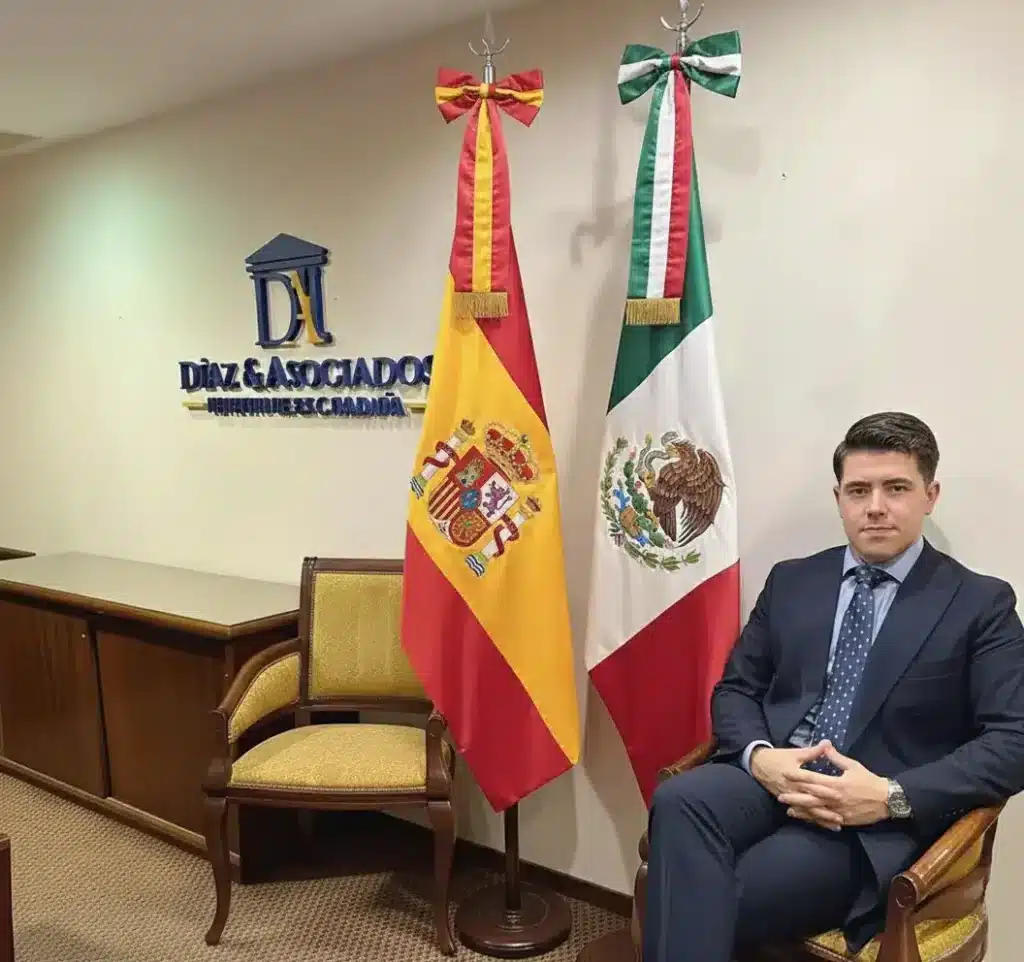
We support you wherever you are. Although our office is in Mexico, we specialise in immigration processes to Spain, offering a close, clear service fully focused on your goals.
From here, our team of Spanish immigration lawyers advises Mexican citizens on Spanish visas, residency and citizenship, coordinating each process with professionals in Spain to ensure legal certainty, effectiveness and real support at every stage.
Although each type of visa has specific requirements, there are basic documents that almost every immigration process requires:
It must be valid for at least 6 months and have at least two blank pages. If your passport is about to expire, renew it before starting your application.
Issued by the Mexican authorities and apostilled under the Hague Convention. This document proves that you have no criminal record in Mexico. It is valid for 3 months, so it should be obtained close to your consular appointment.
Issued by a registered doctor, certifying that you do not suffer from any disease that could have public health implications. Some consulates have specific forms.
An insurance policy with cover in Spain and no co-payments, covering your whole initial stay in Spain. We work with specialist insurers that meet consular requirements.
Depending on the visa, you will need to prove financial solvency with bank statements, proof of income, tax returns, a letter of financial sponsorship or investments. The amounts vary according to the type of visa and the number of dependants.
Letter of acceptance from a recognised Spanish educational institution, proof of payment of tuition or a reserved place, previous academic documents (degrees, certificates) and the curriculum of the programme.
Job offer from a Spanish company, a registered employment contract, a work authorisation issued by the Spanish authorities (applied for by the employer) and documents proving your professional qualifications (degrees, experience certificates).
Proof of sufficient income or savings (approximately 28,800 euros a year for the main applicant, plus 7,200 euros for each dependant), proof of the source of funds and documents for properties or investments if applicable.
Documents proving the family link (marriage and birth certificates), proof of the sponsor's financial means, proof of adequate housing in Spain and the municipal registration certificate of the family member in Spain.
Timeframes vary by type of visa. Long-stay visas (student, work, residence) generally take between 1 and 3 months from when you submit your complete application at the Spanish Consulate in Mexico until you receive a decision.
However, you should also allow time beforehand to prepare documents (1-2 months), obtain documents in Mexico and Spain if applicable, official translations and apostilles. Overall, we recommend planning 4-6 months ahead of your intended travel date.
Yes. Mexico and Spain have excellent bilateral relations and there is a significant flow of workers between the two countries. To work legally in Spain you need one of these:
Option 1 – Work visa: If you have a job offer from a Spanish company, the company applies for a work authorisation from the Spanish authorities, and you then apply for your work visa at the consulate in Mexico. Once in Spain with this visa, you can work legally.
Option 2 – Student visa with permission to work: As a student you can work up to 30 hours a week during your studies, which lets you gain experience and cover part of your expenses.
Option 3 – Digital nomad visa: If you work remotely for employers or clients outside Spain, this visa lets you live in Spain while you work online.
Option 4 – Getting Spanish citizenship first: If you qualify by option, you obtain Spanish citizenship and can work freely without restrictions in Spain and throughout the European Union.
Once you have a work permit and live legally in Spain, you have the same employment rights as Spaniards: minimum wage, social security, paid holidays, employment protection, etc.
No. As a Mexican citizen, you can visit Spain (and all Schengen Area countries) without a visa for stays of up to 90 days in any 180-day period. You only need a valid Mexican passport.
However, although you do not need a tourist visa, the Spanish border authorities may ask you on arrival for:
• A return or onward ticket
• Proof of accommodation (hotel booking or letter of invitation)
• Proof of financial means (credit cards, cash, bank statements)
• Travel insurance (recommended, although not always required)
Important: If you plan to stay longer than 90 days, work or study in Spain, you CANNOT do so as a tourist. You need the corresponding visa, applied for in Mexico BEFORE you travel. It is not possible to arrive as a tourist and switch to a residence visa while in Spain (except in very specific cases of arraigo).
Yes, in most cases you can include your family. The options depend on your type of visa:
Initial inclusion: With work, non-lucrative residence and digital nomad visas, you can include your spouse or registered partner and minor children (or adult children who depend on you financially) from the start. Everyone applies for their visas at the same time and travels together.
Later reunification: If you move on your own first (for example, with a student or work visa), once you are settled and meet certain requirements (generally 1 year of legal residence, sufficient financial means and adequate housing), you can bring your family over. Your family members obtain residence permits linked to yours.
Family members who can come:
• Spouse or registered partner
• Children under 18
• Unmarried children over 18 who depend on you financially and are studying
• Parents over 65 who depend on you financially (in specific cases)
Each family member needs their own documents (passport, certificates, health insurance), but the applications can be made together. Costs multiply (consular fees for each person), but the process is the same.
Reunited family members obtain permits that allow them to live legally in Spain. Depending on the type, they may also be able to work or study.
Although technically you can apply for a visa on your own, hiring a specialist lawyer is highly advisable in these cases:
Complex situations: If you have had previous visa refusals, past immigration problems, a criminal record that needs explaining, or your situation does not clearly fit a standard type of visa.
Significant investments: Setting up a company in Spain or any process involving a significant investment of capital.
Citizenship: Option and other family routes require reconstructing your family history, obtaining records in Spain and dealing with Spanish Civil Registries, which is much easier with legal representation in Spain.
High-stakes processes: When your career, your family’s move or your future depend on approval. A refusal can delay your plans by 6-12 months or more. Professional advice gives you peace of mind and maximises your chances of success.
Lack of time: If you are working and do not have time to research changing requirements, gather documents, arrange translations, apostilles and consular appointments, and follow up constantly.
Maximise your chances: Our approval rate is above 95% because we know exactly what consulates look for, how to present solid cases and how to anticipate potential problems. An expert lawyer can make the difference between approval and refusal.
Special cases: Arraigo, regularisation, administrative appeals or any situation that requires in-depth knowledge of Spanish immigration law.
Yes, there are several routes for a Mexican to get Spanish citizenship:
By residence (most common): The general rule is 10 years of legal residence in Spain, but nationals of Ibero-American countries such as Mexico only need 2 years of legal residence to apply.
Requirements:
• 2 years of legal and uninterrupted residence in Spain
• No criminal record in Spain or in previous countries of residence
• Passing the CCSE exam (Constitutional and Sociocultural Knowledge of Spain)
• As native Spanish speakers, Mexicans are exempt from the DELE A2 language exam
• Proving integration in Spain
By descent (Democratic Memory Law): The deadline to request an appointment closed on 22 October 2025. Files submitted in time are still being processed.
By option: Among other cases, people whose father or mother was Spanish and born in Spain can opt for Spanish citizenship, with no time limit.
By naturalisation letter (carta de naturaleza): In exceptional cases of outstanding services to Spain or special circumstances.
Once you obtain Spanish citizenship, you are a European citizen with all the rights that go with it: a Spanish passport, voting in elections, living and working freely throughout the EU and access to public services. And the best part: Mexico allows dual nationality, so you do not lose your Mexican citizenship.
Your life project in Spain deserves legal certainty and professional support. Our team of specialist immigration lawyers advises you from Mexico so you can make clear decisions and avoid mistakes from the start.
We serve clients throughout Mexico and also online, adapting to your situation and answering your questions with care, clarity and commitment.
Book your initial consultation today and start your move with confidence.
We are here to help you turn your goal of moving to Spain into reality.
Mándanos un mensaje